
And Gladly Would He Read, and Gladly Teach:
An Autoethnodrama
The play is to be presented in a “Reader’s Theatre” style as this style employs the elements discussed in the study from previous chapters: read aloud and performance of text. Each cast member will have a book in hand in which to read from as the play unfolds. Think of this more as a “staged reading” as opposed to a traditional play production.
The “set” should be simple: only stools or chairs to indicate desks for students. Do not use actual desks as that will impede the movement of the actors in times when they need to move. Above the playing area there will need to be a screen in which to project various text, images, etc. as called for by the play.
As the play begins, a young man sits center stage, he appears to be working on lesson plans, grading papers, etc. The narrator comes forward and addresses the audience.
Narrator: Hello, and welcome to my dissertation defense. This is without a doubt a most formal introduction and one that I will, after today, never use again. Having said that, this performance is an accumulation of research done on the subject of my practice as a teacher. It is an autoethnography, (there is a slide change during these with definitions for the audience of these terms) and the format that you are watching is an ethnodrama or, more accurately an autoethnodrama because this play depicts my personal experiences and perceptions.
In the development of my study I have pursued several research questions, but one question in particular has provided me the most engagement and drive to work on this study. That question is: Can the performance of literature and read aloud practice unearth the desire to read for enjoyment in students? (The previous question is displayed on a screen above the performance area).
And now for a disclaimer, today’s performance will not provide an explicit answer to this question, but through the process of creating this autoethnodrama, my questions have been answered. My hope is that today’s performance will give you, the audience, the essence of what my experience has been these past 25 years as an educator. I hope to do this by sharing with all of you my perceptions of the classroom experience along with the words of my students. I can make no claim as to if their words accurately depict their experience, I can only vouch how they have affected me and my practice as a teacher. I can only claim how their words have changed my use of read aloud and the performance of literature as instructional tools. And so, with that, cue the actors.
(At this point, the cast takes their place in our classroom.)
The following is a true story of a young man. All this young man ever wanted to do was to become teacher. He wanted to share his love of literature and language with others in the hope they might gain knowledge and understanding about their world through stories created by wonderful writers.
The following is from our protagonist…
Chorus: and researcher’s
Narrator: first few years of teaching.
Mitchell: It was my third year of teaching and I was assigned a class of low-level readers who in their own words stated that they,
Chorus: HATE READING!
Mitchell: Part of the prescribed curriculum for this class was to have students read silently for the first 15 minutes of class…
Chorus: … every day.
Mitchell: It was called: Stop, Drop and Read. But I soon renamed it,
Chorus: Stop, Drop and Nap.
Mitchell: (During the following narration, students alternate between falling asleep and being redirected to “read” as described.) I was constantly having to re-direct students to wake-up and read. I was reminded of my own school experience of silent reading time. It was awful and I felt complicit in doing the same harm to my students that I felt was done to me. So, I made a decision that would, unbeknownst to me, become the focus of this study and autoethnodrama you all are watching now.
(Students are talking and acting as students do before the bell starts class. Bell sounds.)
Hello, everyone, that was the bell so please find your seat. (Some students begin to take out their independent reading). Do not bother getting your independent reading out for class today. We will be trying something a bit different. (Some moans and groans coupled with slight interest from other students.) We are all reading Of Mice and Men currently in class. I thought I would read some of it to you today aloud in place of our independent reading time. So please open your books to chapter two and follow along starting at the second paragraph. (Students slowly comply.)
At about ten o’clock in the morning the sun threw a bright dust-laden bar through one of the side windows, and in and out of the beam flies shot like rushing stars. The wooden latch raised. The door opened and a tall, stoop-shouldered old man came in. (Mr. Mitchell transforms his body as he reads the description. Some students notice this and laugh slightly.) He was dressed in blue jeans and he carried a big push-broom in his left hand. Behind him came George, and behind George, Lennie. “The boss was expectin’ you last night,” (Students laugh at the voice created for this read aloud.) the old man said. “He was sore as hell when you wasn’t here to go out this morning.” He pointed with his right arm, and out of the sleeve came a round stick-like wrist, but no hand. (Students freeze in their positions).
Narrator & Mitchell: What happened in class that day was amazing.
Mitchell: I did not have to redirect anyone to pick their head up even once. They all listened intently and followed along until the fifteen minutes was up and we moved on to another lesson for the day.
Narrator: It very well could have been the novelty of the activity that kept their attention, but he could not deny the fact that their attention was on the story and not off task, and their exit slips showed just as much.
Mitchell: I read the exit slips from that day and knew immediately I was onto something.
Teacher’s Pet: When you read stuff and read them in character it’s AMAZING! The reading today for Of Mice and Men really stuck to me because we (the class/ chorus all nod in agreement) really got into the whole story and I felt like I was part of the story while you were reading it.
Lost: I really enjoyed the performance in class today because it helps me learn better. Steinbeck is difficult to understand and you can sometimes get lost with the different characters he uses, but when you read and act out these characters and use different voices it gives me a better sense of what is happening.
Vegas: I really enjoyed the read aloud today because it made the class fun and time flew by. But my favorite part by far was when you asked us to drop a beat so you could do the rap. (There is an all-out music section in which the Mr. Mitchell and various students perform a “rap” to the novel).
If Lin-Manuel Miranda Wrote
Of Mice and Men
My name is George
And my best friend is Lennie,
Between the both of us
We ain’t got a penny.
So sit right back
And listen to the story
That many have called
A Bible allegory.
Hi, I’m Candy
From Of Mice and Men
And I sweep out the bunkhouse
And bring the buckets in
I got an old dog
Who’s just about to die
But when they come to kill ‘em
I’m really gonna cry.
So the boss man’s son
Has married this tart
And both of them
Are cold at heart.
Curly’s a punk who’s
Short and mean
And he wears this glove
That’s filled with vaseline.
One night he snaps
From all his distrust
And Lennie grabs his hand
Squeezes and makes it bust.
Now George is worried
But do not fear
For Slim’s word is law,
“Don’t can these guys, you hear?”
So Lennie’s safe and
Can still tend them rabbits
But he still needs to watch
This one bad habit.
See, he likes to touch
And feel soft things
He can’t control it
We know he ain’t mean.
But one Sunday
Out in the barn
Comes Curly’s wife
Spinning a yarn.
Seems she’s not so bad
In fact she’s kinda trapped
And soon after this
Lennie makes her neck go SNAP!
“Go to the brush
Is what George said.”
Which is what Lennie does
Then George shoots him dead.
So that’s the story
Of Mice and Men
A story of woe
And not much Zen.
(Everyone goes back into their original places.)
Mitchell: Because of the positive responses, I continued to read the story aloud in class, and continued to ask for feedback through exit slips.
Straight Talk: If you ask me, I think you love the sound of your own voice.
Mitchell: Of course, not all of them were positive.
Lemon: I asked for a pass at the beginning of the year to see my counselor so I could drop this class mainly because I hate reading. You didn’t give me the pass. You didn’t seem to care what I thought then, why do you care about what I think now?
Chorus: Ouch!
Mitchell: These exit slips gave me a window to monitor my own practice as well as a view into the thoughts, feelings, and attitudes of my students.
Decaf: This class is okay. Nothing memorable, just okay.
Flame Brain: We got really attached to the characters and with you playing the characters made it more heart breaking. I saw some girls crying twice during this story. The first time was when they killed Candy’s dog and second time was at the end when Lennie was shot. I think you even got choked up during the reading that day. It’s like you lose yourself in the story.
Mitchell: I started to use read aloud in other classes besides the low-level ones to see how students responded.
Narrator: As the years went on, teaching opportunities opened for our protagonist in ways that would excite and ignite his passion for cross- curricular education. He was given the opportunity to teach a combined class of American History with American Literature.
Chorus: It would be more of a humanities class.
Narrator: Our protagonist could not wait to share his practice of read aloud with others from different disciplines.
Mitchell: We should read the first part to Of Mice and Men aloud to get the class started,
Narrator: He said to his co-teacher, Carli. Nothing in the statement seemed out of place or too outlandish of a request as far as he was concerned. It is a practice he had done for years, reading aloud to students and especially from this novel. And from the look on Carli’s face, all seemed fine. (The actor playing the role of Carli, makes a face and the chorus responds with a shrug). She did not question the motive for wanting to read aloud or even the amount of classroom instruction that it might take in order to do such an activity. In fact, she seemed curious if not excited about prospect of this activity as she had stated that she had not ever really tried a read aloud activity in class. Her primary teaching load was in history/ social studies and the class they had just started teaching together this year was her first venture into a language arts class.
Mitchell: Later that day as I read aloud to the class with my co-teacher modeling how our students should be following along, I got to the dialogue between George and Lennie. At this point, as my students would say,
Chorus: things got weird.
Mitchell: As the narrative of the story switched from mostly prose to mostly dialogue, I read the dialogue as I always have…in character… with voices… and with emotion. Below is the section I am referring to:
(The actor playing Mr. Mitchell reads the following in character.) “Lennie!” he said sharply. “Lennie, for God’ sakes don’t drink so much.” Lennie continued to snort into the pool. The small man leaned over and shook him by the shoulder. “Lennie. You gonna be sick like you was last night.” Lennie dipped his whole head under, hat and all, and then he sat up on the bank and his hat dripped down on his blue coat and ran down his back. “That’s good,” he said. “You drink some, George. You take a good big drink.” He smiled happily (p. 3).
Narrator: Nothing out of the ordinary for him who had read this section of the story for years aloud to juniors. The students all seemed engaged: on the correct pages of the novel as he read and even laughed when appropriate at the banter between George and Lennie. But the look of horror and dismay on his co-teacher made him wish he had played a game or two of poker with her prior to this day. (Again, we see her face, but it is much different than before and the chorus reacts to it as such.)
Mitchell: She could not conceal her worry. It was clear to me that from this look on her face, I had made a grave mistake of some kind that I (or we) would pay dearly for in the near future. All I could think was,
Narrator & Mitchell: “What have I done?”
Mitchell: Once I finished reading the passages we had planned to get through for the day, we moved on to the next objectives for the class. Both of us wanted desperately to talk and discuss the read aloud activity, but with a captive audience of 30 plus juniors, we would have to wait until our common prep period to do so. Later, that day when Carli and I both had time to reflect on the lesson and to review exit slips of our students, she commented that she was not prepared for me to embody the characters as I did. In fact, she was more than a bit worried that my portrayal of Lennie might offend some in the class.
Carli: I’m more than a bit worried that your portrayal of Lennie might offend someone.
Mitchell: Why?
Carli: Well… you really made him sound as if he was mentally impaired.
Mitchell: Good. That’s what I was aiming for. (Carli makes a face).
Chorus: The befuddled look on Carli’s face was priceless.
Carli: That look of befuddlement on my face later changed to acceptance. As we poured over the exit slips of the day, a number of students had commented that the voices helped their understanding of the characters better than if they had read the section on their own. As we continued through the book, one student had stated that as he read the novel he heard Mr. Mitchell’s voice in the characters and that it had helped him keep the characters
Lost: “straight in his head.”
Carli: This comment reminded me of a popular meme with the character Dwight from the TV show, The Office which I later shared with Mr. Mitchell. (The Meme is shown on a screen above the actors).
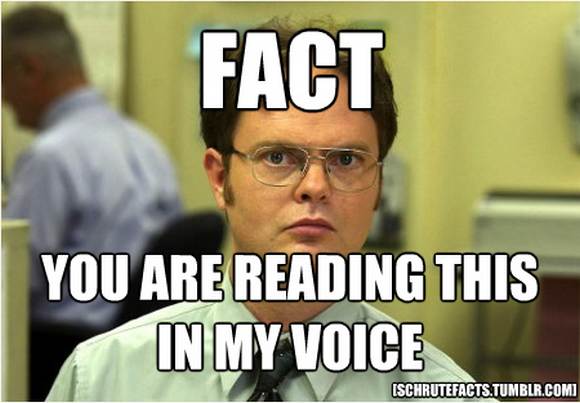
When both of us look back at this day, we laugh realizing that what had happened in the class was a turning point for both of us as a team.
Mitchell: There is a bond,
Mitchell & Carli: a trust between co-teachers that mirrors,
Mitchell: I can only assume,
Narrator: the same kind of bond two soldiers in battle must have.
Carli: Since I started teaching with Mr. Mitchell, I have employed the use of read aloud in my other classes as well.
Mitchell: I dare say, that our practices have both improved as I have learned as much from her as she has from me. Yet, the reality of not being able to get through to all students remains as a great pain to me and my practice.
Sheepish: I am the student who sits in the back.
Lost: I am the student who is always on their phone.
Decaf: I am the student with their head down.
Stage Fright: I am the student who refuses to speak.
Powerless: Leave me alone.
Full Meter: Get out of my business.
Lemon: Stay out of my life.
Sheepish: Don’t ask me how I am feeling.
Lost: Don’t ask me if everything is alright.
Stage Fright: Don’t excuse me.
Lemon: Don’t put up with me.
Decaf: Don’t lower your standards for me.
Powerless: Reject me.
Stage Fright: Fail me.
Powerless: Punish me.
Full Meter: Don’t try to talk to me… Don’t try to… Don’t…
Mitchell: The exit slips, for the most part are positive. Yet, I still get those that are less than encouraging.
Straight Talk: You are entertaining, but I can’t say you are helpful. I’m not learning anything in your class.
Thoughtful: In class you are always willing to act out a poem or play a character if we are reading a play out loud. Your dramatizations of various stories are always intriguing. But I am not sure if I am learning anything.
Lemon: Today you played a CD of To Kill a Mockingbird because you’ve been reading so much of the book out loud to us that you’ve lost your voice. You should do that more, the CD is better than you reading anyways.
Lost: I did not know until today when you played the CD for To Kill a Mockingbird that Scout was actually a girl. I think it might be because you’ve read it so much in class I just kept hearing a guy’s voice when reading the book on my own. I felt really stupid when you mentioned this in class.
Straight Talk: I think it is amazing how you can read Lord of the Flies aloud with all the boys in different sounding voices along with the British accents. It really is cool and it helps me keep all these characters straight in my head. But you should know something, Lord of the Flies is the shitttiest book ever written. EVER!
Lost: You jump around from one topic to another too fast. A lot of us can’t keep up and I bet I’m the only one who’ll say anything about it.
Mitchell: Clearly, some of my read aloud practices seemed to work, but others did not.
Narrator: In the following years, he would continue to reflect (we see Mitchell journaling in his book, working on lesson plans, etc. during this narration) and think of new ways to incorporate read aloud and performance into his teaching practice.
Mitchell: The biggest change for me was giving more of the read aloud activities to the students in class. This caused a number of reactions.
Stage Fright: I hate reading in front of my peers and for you to “require” us to do so is not fair. Especially when some of us have legitimate anxiety issues.
Sheepish: Agreed. I will say that you are very understanding, but, I still hated doing the read alouds and can honestly say I did not get any better at it as I got one of the lowest grades in the class.
Full Meter: You know what I hate most about this class? Having to read out loud.
Mitchell: So I had to try some different tactics in regards to read aloud as an instructional tool. I started to allow time for practice before the read aloud activities along with more modeling of what I expected from my students. Based off of the feedback from my students, it seemed to be working.
Thoughtful: With the read aloud activities, it is difficult NOT to participate.
Flame Brain: You ask us questions and participate along with us in reading poems, stories and plays. You can bring a passage to life like no other person I know.
Vegas: I like how you don’t just tell us to do something; you demonstrate it first, no matter how ridiculous it is.
Narrator: A teacher’s realm often extends outside of the four walls we associate as the classroom.
Mitchell: I have spoken to various coaches about how they treat the field as an extension of their classrooms. The same is true for me as a drama director.
I treat everything that happens in the theatre as a part of my classroom meaning I have the same rules and expectations in the theatre as I would in the classroom.
Narrator: Having said this, his “class load” for shows will at times reach numbers up to and past 60 students.
Mitchell: All of them with different
Vegas: talents,
Thankful: abilities
Straight Talk: and needs.
Mitchell: Many of these students I never have the pleasure of having is class, but I have noticed issues in some of these students that should have been noticed by classroom teachers prior to my encounters with them in theatre. I am certain that these issues would not have been discovered without the use of read aloud practices. Case in point,
Curtis & Jared: Curtis and Jared.
Mitchell: Curtis and Jared are two very gregarious and likeable students. Both of them performed leads in shows with much acclaim and success.
Jared: Jared in particular was selected as an All-state cast member at the IHSA state competition for contest drama his senior year.
Curtis: Curtis too, was selected as an All-sectional cast member his senior year and just missed the state competition by three points.
Jared: Jared was actually in the “gifted” program while attending high school but received average grades in all subject areas.
Curtis: Curtis was in regular level classes and received average grades as well.
Jared & Curtis: Both are creative in their writing, but according to their English teachers neither would be able to complete the first round in an elementary spelling bee contest.
Mitchell: What I found during our first read through was rather distressing.
Narrator: A read through is traditionally the first rehearsal of any production in which the cast and crew sit in a circle and read through the play reading their respected parts.
Mitchell: Both Jared and Curtis labored in this task to the point of irritation from their cast members. Both would shrug it off; Jared would comment,
Jared: It’s just my nerves getting the better of me,
Mitchell: and Curtis would complain that…
Curtis: my glasses are so dirty, it makes it hard to read the script cold.
Mitchell: As a teacher who has students read aloud on an almost daily basis, I saw what I felt deeply was an undiagnosed learning or reading disability.
Narrator: Going through the channels to seek support for them, his suspicions were confirmed for both. Jared’s parents at first, as one might expect, were furious.
Parents of Jared: How could our son have gone through school up to his senior year without anyone noticing this?
Mitchell: Later what we learned and realized was that Jared found ways to cope with and hide this disability. The same was true for Curtis. For example, both of these young men worked very hard to get their lines down as early as possible having family and cast members do “line-bashes” with them.
Narrator: In a “line-bash” the actor is read the line aloud when they miss a cue or rephrase a line. It was through this process that they would get their lines memorized without having to read and re-read the script themselves. However, this method tends to take a bit longer than most in getting these lines down.
Mitchell: It was also a source of frustration for everyone involved.
Narrator: What neither of them really fully admitted until it was pointed out to them was that these “line-bashes” were a coping method for their reading disability.
Mitchell: And this brings up a point that I wish I did not have to… it is a point about how our school system lets many of our students down due to a lack of attention on our side.
Teacher’s Pet: Your class is great.
Lost: Your class is awful.
Vegas: Mitchell is the BOMB!
Lemon: Mitchell is the worst!
Thankful: I feel so independent.
Straight Talk: I feel so babied.
Full Meter: Why are you always in my business? Why are you always in everybody’s business?
Powerless: Why do you still even try?
Sheepish: Leave me alone.
Stage Fright: I want to sit alone.
Sheepish: I want to work alone.
Stage Fright: I want to be alone.
Lost: I want to be…I want to… I want… I….
Sheepish: When you see a student struggling in your class, don’t ask them to read aloud in front of everyone.
(Scene transition).
Mitchell: In almost 15 years of teaching, I thought I had seen just about everything, and then walked in Marcus.
Narrator: A shy, quiet tender young man with one of the worst stammers Mr. Mitchell had ever heard. Every word labored out of him like a vintage car trying to start on the coldest day of February in the morning of Chicago.
Mitchell: He was in my accelerated sophomore English class, and to the credit of every student in the class, no one made fun of his speech impediment and all seemed to empathize with him in a way that made me proud to be an educator. It was clear to me that many in this class had known Marcus for years and had grown accustomed to his stammer.
Narrator: It also became quite clear that this class would be an incredibly difficult one for him as the lion’s share of the work would be constructing and delivering speeches.
Mitchell: Marcus came up to me immediately after class on the first day to ask about the speech requirements and he had a rather unusual request.
Narrator: With his stammer in high gear he asked,
Marcus: Ca…ca…ca…can I do the spe…spe…spe…speeches in a different voice?
Mitchell: Sure. Whatever would make you feel comfortable.
Narrator: The day of the first speech came. The topic: a fear that you had to face. You could sense a certain uneasiness in the room as Marcus walked up to the front to deliver his speech.
Mitchell: It could have been that it was just my own uneasiness or sympathy for a young man who I felt was dreading this assignment.
Narrator: For many who fear public speaking, this would be a most arduous task. For someone with a stammer like his, it would be painful.
Mitchell: However, what came out of his mouth surprised no one in the room but me.
Narrator: Marcus gave a hilarious speech about a roller coaster ride he went on earlier that summer.
Mitchell: The word choice, pathos and ethos of his speech was at par with other speeches I had seen and heard through the years as a communications teacher. What he said and how it was constructed did not surprise me.
Narrator & Mitchell: It was the voice;
Narrator: Marcus had delivered the speech entirely in a British female voice. It should be noted that he did not stammer once during the delivery.
Mitchell: Had the subject not been so serious, I fear I might have laughed and offended him. The voice seemed so ridiculous at the time. After class he approached me and asked,
Marcus: Ha…ha…ha…how did I da..da..da..do?
Mitchell: Fantastic. I will get the rubric to you tomorrow after I make a few more notes.
Marcus: Tha..tha..thanks.
Mitchell: Do you mind if I ask you a question? (Marcus nods.)Why a British dialect?
Marcus: No real rea..rea..rea..reason. I ju..ju..just feel more com…com…com..comfortable doing it.
Mitchell: It had not crossed my mind to ask him why a female voice. I think deep down I knew the reason I did not.
Narrator: Later in the semester Mr. Mitchell encouraged Marcus to audition for the school plays he directed.
Mitchell: We had been reading Julius Caesar in class and he volunteered daily to read, preferring the roles of Portia (wife of Brutus) and Calpurnia (wife of Caesar). Each time he read he would read in the British feminine voice the class had grown accustomed to hearing.
Narrator: One day Mr. Mitchell challenged him to try a different voice, which Marcus did and in the middle of class Mr. Mitchell explained to him that he needed people who could do voices for speech team.
Mitchell: You should really should come out for it. You’re funny, you can write and the different voices would be great for our humorous events.
Narrator: Marcus did join the team and wrote an original comedy to compete with for the speech team. He had mild success at first that grew into bigger success.
Mitchell: I continued to ask him to audition for plays and even picked out a show that could show off his talent for various voices.
Narrator: Marcus did come out for auditions and was cast in a minor, but funny role. That’s all it took. Marcus was bit by the drama bug. The next two years Marcus played many roles with much success and each one of them in a completely new voice. He also continued to compete on the speech team in original comedy.
Mitchell: You should really audition. I could use your talent.
Narrator: Marcus did come out for auditions and was cast in a minor, but funny role. That’s all it took. Marcus was bit by the drama bug. The next two years Marcus played many roles with much success and each one of them in a completely new voice.
Mitchell: I often referred to Marcus as “Mel Blanc.” One role in particular went through many transformations. What started off as a Christian Bale “Batman” voice eventually ended up as a much softer impression of Daniel Day-Lewis’s version of President Lincoln. In this particular role his senior year he made All-sectional cast and qualified for state in our contest drama.
Narrator: Marcus’s first year out of high school, he began to transition. Known now as May, she is becoming more confident, but it has not been an easy battle as she faces challenges every day.
Mitchell: May does not speak with a British dialect anymore, nor does she have a stammer. The speech impediment seems to have disappeared while her true identity has been found. When she can, May continues to audition for plays and has found a home on the stage. It is my belief that the read aloud activities in class may have lead (in some small part) May to her truth. When I have asked her about this, she agrees and states that she,
May: Cherishes the time spent on stage in high school and those days reading in class.
Mitchell: The read aloud practices in my class have strengthened this relationship, but I know all too well that this practice has also kept me from being able to develop relationships as well.
Stage Fright: I don’t like it when we have to get up in front of the class and read. Even if we are in small groups. Just because I am not by myself doesn’t make it better.
Straight Talk: I get why we need to read a lot of this stuff in class out loud. It’s because most of the kids won’t do it on their own. Well here’s something you should know, that’s their choice. Don’t make me suffer because of them.
Sheepish: You know, I take it back. I am beginning to like this and I see that I am getting better.
Stage Fright: I kind of like reading out loud on my own when I am sitting at my desk. Doing the group or choral readings, especially on our feet in front of everyone, sort of slows me down and it’s boring.
Straight Talk: I still hate reading aloud and I still think it is punishment.
Mitchell: Because this seemed to be working with most of my (student #3 and Mitchell exchange looks) low-level and regular students, I began to do this with my accelerated and AP students. Student feedback continued to be used.
Full Meter: We’re an AP class…we can and should read a lot of this material on our own and outside of class.
Mitchell: Again, I would see that I could not please everyone. But much of the feedback was positive.
Thankful: I really enjoy having you, Mr. Mitchell, as my AP English teacher because you make the learning fun. What I enjoy the most is how you act out parts of Shakespeare and get us all engaged in the read aloud activities. My favorite was when we read Macbeth today in class and you had us do the up and down activity. It wasn’t really a read aloud activity, it was more like a game. (Slight change on stage as the “class” re-enacts the lesson.)
Mitchell: Okay, before we move on, I need two volunteers to read Macbeth and Lady Macbeth. (Two students raise their hands and are assigned parts.) Please begin.
LADY MACBETH
Enter MACBETH
My husband!
MACBETH
I have done the deed. Didst thou not hear a noise?
LADY MACBETH
I heard the owl scream and the crickets cry.
Did not you speak?
MACBETH
When?
LADY MACBETH
Now.
MACBETH
As I descended?
LADY MACBETH
Ay.
MACBETH
Hark!
Who lies i’ the second chamber?
LADY MACBETH
Donalbain.
MACBETH
This is a sorry sight.
Mitchell: Please stop there. Great job. If you would, please read it again, but this time stand up every time Macbeth speaks and sit down when Lady Macbeth speaks. (Some laughter prior to the students complying and re-reading the text from above.) Great, now if you could read it again, maybe this time a bit faster and we’ll have the whole class join in the fun of sitting and standing as well. (The class, and audience are encouraged to participate, the reading might be done two or three times this way.) Now, everyone sit and quickly check your heart rate and even you breathe rate. (Everyone complies.) What do you notice?
Teacher’s Pet: My heart is racing.
Decaf: My breathing has picked up and I feel like I’m in gym class. (Students laugh at this).
Mitchell: We know that Macbeth has just killed King Duncan in his sleep prior to this dialogue. What do you think Macbeth is feeling right at this moment in the play?
Thankful: Macbeth is possibly shaking from the fear of what he has done.
Teacher’s Pet: I would imagine all the adrenaline running through his veins would make it hard for Macbeth to think clearly.
Thankful: Yeah, and hasn’t he been seeing things already that aren’t really there?
Teacher’s Pet: Yes, and that could mean a number of things, like he is thinking about this major sin so much it’s all consuming.
Full Meter: His heart is jacked, man, ‘cuz he just like killed someone.
Mitchell: Awesome! These are all great observations. Now, do me one last favor, turn your text one quarter of the way counterclockwise and tell me what you see in regards to the text. (Students comply and a picture of the text is projected on a screen above the actors.)
Lost: Well, the lines go up and down a lot.
Teacher’s Pet: Kind of like hills or a roller coaster.
Thankful: (With a look of awe on their face.) It looks almost like a heart monitor.
Mitchell: That’s correct. It does. Now what do you suppose… (As the dialogue fades out in the class lesson, the stage goes back to the setting it had prior to the class lesson.)
Thankful: Who knew that Shakespeare could be so much fun. The class is hard, but these activities give it levity and takes a lot of pressure off of us as many of us take 3 or 4 other AP classes. It’s nice to have a class to look forward to out of a day filled with a stressed packed schedule. Thank you!
Narrator: Not long after, this young man was given the opportunity to lead the English department as the Department Chair. He was given this opportunity, he was told, because he was a master teacher who could help others become master teachers as well. The only catch, he would be in the classroom less than he had ever expected.
Mitchell: What have I done?
Narrator: In his new position, he went from teaching five classes to teaching two in order to do Chorus: administrative duties.
Narrator: The new position took some getting use to, and it also started to affect his teaching.
Chorus: His students noticed a change.
Full Meter: If we don’t get something you get unjustifiably frustrated.
Lemon: I can’t tell if you are frustrated with something outside of our class and if you are bringing it with you into the classroom, but I think you should be aware that you are upsetting a lot of us.
Powerless: You have so much power and sway over the attitude of this class and lately, you seem impossible to please.
Mitchell: What have I done.
Mitchell & Narrator: (During this line, the narrator and actor playing Mitchell trade places). This young man was no longer a new teacher,
Narrator: but a veteran of the education system that increasingly falls under attack for various reasons; some that are justified, many that are not.
Mitchell: Recently, this man thought about his younger self and asked,
Narrator: Why am I in this position? Do I even like leading a department? I am a teacher, but am I a good teacher? In this job as Chair, I can’t do justice to both titles: Chair and teacher. I feel trapped with no way out.
Mitchell: And as luck would have it, the leadership structure of his school was changed and he was given the opportunity to apply for a leadership position that would remove him from the classroom completely.
Narrator: The choice was an easy one.
Mitchell: He decided to return to the classroom full time as well as to begin a program toward earning a doctorate in education.
Narrator: I thought of it as a chance to renew and challenge myself,
Mitchell: but he had not anticipated how.
Various Chorus in “Popcorn” Style Reading: First writing assignment: In the manner of your choosing, describe your educational philosophy. Be sure to explain how you came to your beliefs and values as an educator.
Narrator: What if I wrote a play in which my students could interview me? (There is a scene shift and the “interview” begins).
Teacher’s Pet: Why did you go into teaching? Did you enter college with the purpose of becoming a teacher?
Older Mitchell: Neither of my parents went past high school and both always felt “bad” about it and encouraged my two sisters and I to go to college and beyond if we wanted. It’s probably no surprise that all three of us ending up working in education. (My oldest sister is a college professor and my other sister worked for more than 20 years as a fundraiser for various colleges.) I knew back in high school I wanted to be a teacher; the question was what kind of teacher (I thought about special education and history). I went specifically to Illinois State University because of the education program and figured out my path to an English, Speech and Theatre education degree. I guess you could say this was inevitable as I did all of these activities in high school and did them quite well.
Vegas: What do you like the most about your job?
Older Mitchell: I love reading literature (especially aloud) and discussing literature with students. I always get a kick out of seeing students understand a piece of text that they could not wrap their head around only to come to not just understand its meaning, but to really fall in love with it. I have had students struggle with various writers (Shakespeare, Hemingway, Steinbeck, Morrison, etc.) only to ask me later about other texts so that they can read more on their own.
Most of all, I really love working with students as they make me laugh on a daily basis. I like to think they keep me young too, but there are times I think they make me old, grey and bald. All joking aside, I really enjoy working with kids because you can see the impact immediately. They are an honest audience.
Flame Brain: That’s an interesting choice of words: audience. Would you say that you perform for your class?
Older Mitchell: Well, yes. I think that all social interactions are in a way a bit of a performance and schools are full of social interactions. More specifically, I would have to say that I perform much of the literature for my students in order to really get them to picture what is happening in a story, play or even a poem. A lot of the time students do not want to be in school, let alone an English class, and by “performing” for them, it can make the time more bearable. However, to be fully honest, I enjoy performing the literature too as it allows me a form of expression and I encourage students to do the same as they read aloud in class.
Thankful: Thanks for sharing. You often stay at school late to lead extra-curriculars. How did you begin doing so? Is there any benefit that the school gives you for doing so (besides your own enjoyment)?
Older Mitchell: I was involved in many activities and sports while in high school (speech team, drama, music, track, football, weightlifting, etc.) and knew that I would want to do the same when I became a teacher. As far as I am concerned, this is the reason that many of our students come to school in the first place (they aren’t beating down the doors for Earth Science or British Literature). I do get paid, and rather well in comparison to other school districts, for doing the activities I do. But I have never done these activities for the money. I do it for the challenge, for the memories it creates for students and myself, and for the opportunity to create “art” in all honesty. But the biggest reason is that these activities are platforms for the biggest educational accomplishments many of our students will have in high school. The stage is my classroom too. I am trying to teach students about teamwork, literature and a variety of other objectives.
Straight Talk: You say the stage is a classroom, what do you mean by that?
Older Mitchell: I have always said to myself and to my fellow peers that I see myself as a teacher first and an artist second. I have known plenty of high school theatre directors who feel bitter: that they may have made the “wrong” choice in choosing a “safe” career over one that is more creative and artistic, such as being a full time actor or theatre director. I, myself, have never felt that way. I see the high school stage (in which I spend many long tedious and joyous hours putting together dozens of shows through the years) as an extension of the classroom. Lessons can and are to be learned on the stage. The way in which you communicate in the classroom is not all that different in how you are to communicate on or via the stage. Once the tardy bell rings, I close the door and begin my “bell to bell” instruction for the day and the same goes for the curtain: if the show time is 7:30 pm you need to start at 7:30 pm and not a minute later as you will be teaching your audience not to respect your call time for a show. Principals and parents alike would not want to see their teachers starting class five minutes late, why would a play director want to “hold the curtain”?
One of my favorite educational philosophers is Paulo Freire, and he once said, (An image of Paulo Freire shows up on the screen).
Paulo Freire: “The teacher is of course an artist, but being an artist does not mean that he or she can make the profile, can shape the students. What the educator does in teaching is to make it possible for the students to become emergent beings.”
Flame Brain: A stereotype that exists for teachers is that, as the years go on, teachers get depressed or worn out from the work. Do you ever feel this to be true in a way?
Older Mitchell: Yes. I have seen it and I worry about really good teachers getting “burned out” quite a bit. This was something I dealt with a lot as chair of the English department. I think the trick is to keep learning. That is one of the reasons I am working on my doctorate now.
Chorus: End scene.
Professor: I read your paper and I appreciate how personal your writing is. Have you considered what methodology you’d like to use for your dissertation?
Narrator: I was thinking maybe a case study.
Professor: You might want to think about doing an autoethnography. (Everyone freezes and turns toward Mr. Mitchell.)
Chorus: What?
Narrator: Autoethnography? Auto means “personal”; ethno means “cultural” and graphy means “to analyze” but how do these all work together?
Mitchell: And thus his dissertation journey began.
Full Meter: I am the student you want out of your class, the student you hope stays home. You know, the student you never look in the eye.
Lost: I’m doing fine.
Sheepish: I’m OK.
Stage Fright: I’m doing the best I can.
Decaf: You can’t understand.
Powerless: You can’t know.
Lemon: You don’t get it.
Powerless: Listen to what I’m trying to say.
Powerless & Lemon: Listen to what…
Powerless, Lemon & Decaf: Listen to…
Powerless, Lemon, Decaf, Sheepish, Lost & Full Meter: Listen…
Narrator: (Sitting with a laptop typing and reading aloud as he types.) The following is a true story about a young man who wanted nothing more than to be a teacher.
Lemon: You didn’t seem to care what I thought then, why do you care about what I think now?
Narrator: He wanted to share his love of literature and language with others
Straight Talk: You are entertaining, but I can’t say you are helpful. I’m not learning anything in your class.
Narrator: in the hope they might gain knowledge and understanding about their world in stories created by wonderful writers.
Powerless: You have so much power and sway over the attitude of this class and you seem impossible to please.
Narrator: (Frustrated, he slams the laptop shut.) What am I doing? What have I accomplished? Almost 25 years in my career, why am I doing this…now? What kind of teacher am I?
Teacher’s Pet: Don’t you remember how you asked us to give you a number between 1 and 10 on how we feel for the day? That experience made me feel like you really care about how I, we, (the chorus nods in unison as this line is delivered) felt and what was going on in our lives. You are an excellent teacher who makes class enjoyable and fun. Your passion makes learning fun. I also like how you include personal stories in your teaching. It makes the class feel connected. You always made sure that the classroom was a community, like everyone is rooting for one another.
Vegas: You let your students know that you care about them through your humor and sincerity. In the classroom, you make it easy to keep up with the material and always offer us assistance when we’re confused. You make the classroom laugh and that helps build a strong sense of community.
Thankful: You are unafraid to tell people when what they were saying or doing is wrong or harmful. I could always have more difficult conversations with you because you are a very open teacher that isn’t afraid to try and connect with students. You always do whatever you can to help me out. You are like a father figure to me.
School Offspring: I would describe you as being a father for me when I needed one. When my own father wasn’t really around I knew I could always talk to you after school if I needed to get anything off my chest and needed some advice. You will forever be one of my most favorite people in the world since I know that no matter what you will be able to always bring joy to students. You made my high school experience not just memorable, but for me also bearable. Mr. Mitchell is one of the only adults I really trusted as a teen. You are my mensch.
Decaf: Mr. Mitchell is a fine teacher. I just hate his class. (Students on both sides of Decaf, give them a playful smack/slap, and then to the audience.) What?
Thankful: You were my speech dad, my school dad, my theater dad which essentially says you were a key player in my high school career. I remember you always inspiring students and engaging us and encouraging us to do activities that brought us out of our shell. You made it possible for us to step out of our comfort zones. You always knew our potential and weren’t shy about exclaiming what that potential is. In a time when we were discovering ourselves, you already knew what we would become.
School Offspring: You helped me feel part of the group at a time when we were all awkward and goofy teenagers. You helped me realize it was better to be myself, because being the someone else others wanted was too hard. There’s a reason we started calling “Papa Mitchell.”
Mitchell: (Speaking directly to Narrator.) These testimonies from students, both
Students: good and bad,
Mitchell: are an entire life’s work. While they may not be words written from the greatest writers in all of literature, you know that they have meant more to you and have affected you more than any other text written.
Chorus: What more could one man need to know that he has made a difference?
Narrator: (Mitchell, who has fully transitioned into the narrator role addresses the audience.) And after he was admonished by a narrator he created, he looked into the eyes of his students who were putting on a play from a story that he had written with their words. They were simply telling a story of a man who wanted nothing more than to be a good teacher. They were telling this story,
Students: no, they were sharing this story
Narrator: with others in a way that served the words of the writer, researcher, and teacher in a way which made him swell with pride. They shared this story in the hopes that others would gain knowledge and understanding about their world as teachers.
Chorus: And this man thought to himself,
Mitchell: Fool, you have been a teacher all along.
Mitchell: And then, he thanked them.
Narrator: (With his back to the audience, he thanks his students.) Thank you all for helping me tell my story as a teacher. I will treasure this experience always. Now please, take your bows. (They all bow with his back still to the audience.)
Screen goes to black.
End of play.

 Mike "School Dad" Mitchell